About This Content
This article explains how everyday movement contributes to energy expenditure. It is not exercise advice or fitness guidance. For individuals with mobility limitations or health concerns, consult healthcare providers before making activity changes.
Understanding Energy Expenditure
Total daily energy expenditure comprises several components. Basal metabolic rate (BMR)—energy required for basic bodily functions—accounts for roughly 60-75% of daily expenditure in sedentary individuals. The remaining energy comes from two sources: structured exercise (if performed) and non-exercise activity thermogenesis (NEAT).
Interestingly, for most people, NEAT accounts for more total daily energy expenditure than structured exercise, yet it's often overlooked in discussions about energy balance.
Defining NEAT
Non-Exercise Activity Thermogenesis refers to energy expended through everyday activities outside of sleeping, eating, or structured exercise. It encompasses occupational tasks, household chores, leisure activities, and all incidental movement throughout the day.
NEAT is highly variable between individuals. Two people in similar jobs may expend vastly different amounts of energy based on work habits, commute patterns, and leisure-time movement. This individual variation is substantial and often underestimated.
Examples of NEAT Activities
Occupational Activities
Jobs vary dramatically in energy expenditure. A surgeon standing for hours expends far more energy than someone at a desk. Construction workers, retail staff, and warehouse workers naturally engage in NEAT. Conversely, desk-based office work provides minimal occupational NEAT.
Household Activities
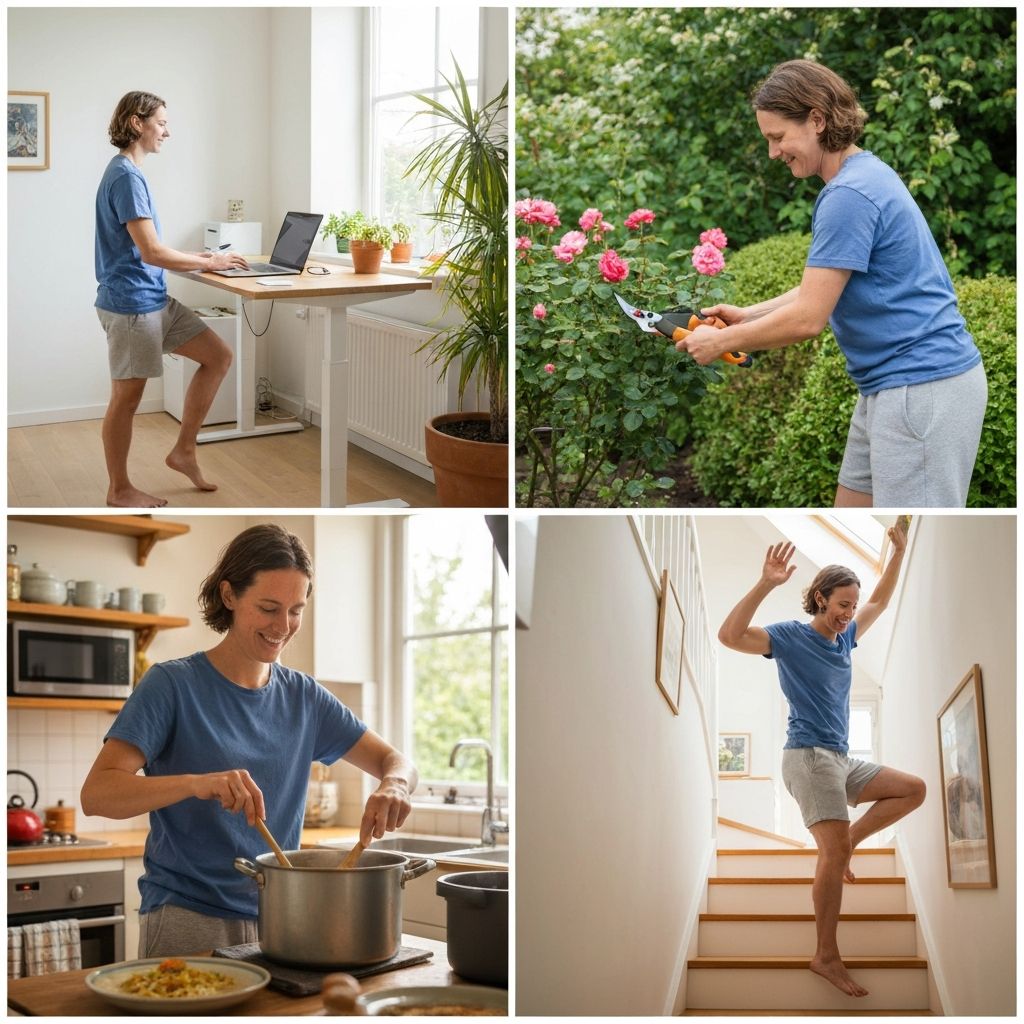
Cleaning, gardening, cooking, and laundry all represent NEAT. Vigorous vacuuming, gardening, or home repairs can expend similar energy as moderate-intensity exercise, yet many people don't account for these activities when thinking about movement.
Transportation
Commute patterns significantly influence daily NEAT. Walking or cycling to work involves substantially more energy than car commuting. Even within driving, parking further away increases walking.
Postural Behavior
Sitting versus standing expends different amounts of energy. Fidgeting, shifting position, and general movement while sitting (sometimes called "fidget thermogenesis") contribute measurable energy expenditure. This element explains why some people naturally expend more energy through subconscious movement.
Leisure Activities
Hobbies involving movement—walking, dancing, playing instruments while standing—contribute to NEAT. Conversely, sedentary hobbies provide minimal expenditure.
How Much Energy Does NEAT Contribute?
For sedentary individuals, NEAT might account for 15-20% of total daily energy expenditure. For occupationally active individuals, NEAT can reach 30% or more. Research shows NEAT can vary by 300-800 calories daily between individuals with similar body size and basal metabolism.
This variation is not insignificant. An additional 500 calories daily—achievable through increased occupational and leisure activity—could theoretically result in meaningful energy balance shifts over time.
NEAT and Energy Balance
Total energy expenditure depends not just on exercise but on daily movement accumulation. Someone who walks regularly, takes stairs, parks further away, and has an active job naturally expends more energy than someone equally sedentary outside of a structured gym session.
Conversely, energy balance research shows that structured exercise alone, without attention to overall daily activity, may have limited impact if NEAT remains low. Sitting for 23 hours with 1 hour of exercise results in lower total expenditure than more distributed movement.
The Modern NEAT Problem
Modern life has reduced NEAT dramatically. Automation, transportation, office work, and increased screen time have decreased daily movement. This shift has occurred relatively recently—within the last century—meaning human biology hasn't adapted to sedentary living.
Increased NEAT through incidental movement is therefore practical for many people and doesn't require formal exercise commitment, making it sustainable long-term.
Practical Ways to Increase NEAT
- Walk when possible - Taking stairs, parking further away, walking for short trips, and standing while waiting all increase daily steps.
- Take movement breaks - Every hour of desk work, stand and move for a few minutes. This breaks up prolonged sitting, which itself has negative health impacts independent of energy expenditure.
- Vary posture - Alternating between sitting and standing, or using a standing desk part of the day, increases expenditure without requiring exercise.
- Incorporate movement into hobbies - Walking while socializing, gardening, dancing, or recreational sports increase NEAT while remaining enjoyable.
- Occupational choices - Long-term, career or job choices that involve more movement contribute substantially to lifetime NEAT.
- Household engagement - Actively doing household tasks rather than outsourcing them increases daily movement. This can be social (family involvement) and productive simultaneously.
NEAT vs. Structured Exercise
Neither NEAT nor structured exercise is inherently superior—both contribute to total expenditure. However, for many people, increasing NEAT is more sustainable than maintaining rigid exercise routines. NEAT doesn't require gym access, special equipment, or time scheduling.
Increased NEAT has additional benefits: it reduces prolonged sitting (which has independent health consequences), provides more opportunities for social movement, and often feels less like "exercise," making it psychologically easier to maintain.
Individual Variation and Genetics
Some variation in NEAT is genetic—some people fidget more, have higher basal restlessness, or naturally seek movement. However, most people can increase their NEAT through intentional behaviour changes. The opportunity for change is substantial for most individuals, regardless of genetic baseline.
Important Note
Individuals with mobility limitations, chronic pain, or specific health conditions may have constraints on increasing NEAT. Any significant activity changes should be discussed with healthcare providers, particularly for those with cardiovascular conditions or orthopedic concerns.